Cultural Resources
Proposed Revisions to the Section 106 Regulations
Current Status
On July 24, 2026, the Advisory Council on Historic Preservation (ACHP) voted to advance proposed revisions to the regulations implementing Section 106 of the National Historic Preservation Act (36 CFR Part 800). This vote advances the proposal through the federal rulemaking process, but it does not change the existing regulations.
For now:
- The current Section 106 regulations remain in effect.
- Projects already in consultation should continue under the existing requirements.
- The proposal must complete additional federal review before it is published in the Federal Register for public comment.
- The draft proposal may change before a final rule is adopted.
Background
Section 106 of the National Historic Preservation Act has guided the federal review of historic properties since 1966. It requires federal agencies to consider the effects of their undertakings on historic properties and to consult with Tribal Nations, State Historic Preservation Officers (SHPOs), and other consulting parties before making decisions that could affect those resources.
The regulations implementing Section 106, found at 36 CFR Part 800, have remained largely unchanged since 2001. The revisions now under consideration represent the most significant proposed changes to the process in more than two decades.
Proposed Revisions
Based on the draft advanced by ACHP, the proposal would:
- Reduce the scope and duration of consultation.
- Expand federal agency discretion over review schedules and certain decision-making responsibilities.
- Narrow the range of undertakings subject to Section 106 review.
- Revise how Areas of Potential Effects (APEs) are defined.
- Place greater emphasis on mitigation rather than avoiding or minimizing adverse effects.
- Reduce opportunities for Tribal participation during consultation.
- Modify documentation and reporting requirements for federal agencies.
Because the proposal is still moving through the rulemaking process, these provisions may change before a final rule is issued.
Potential Implications
If adopted, the proposed revisions would significantly change how Section 106 reviews are conducted for projects involving federal funding, permits, licenses, or land authorizations.
Based on the current draft, the proposed revisions would:
- Narrow the scope of project reviews and how Areas of Potential Effects (APEs) are defined.
- Reduce opportunities for meaningful consultation with Tribal Nations, State Historic Preservation Offices (SHPOs), and other consulting parties.
- Limit opportunities for public participation by reducing consultation requirements and increasing agency discretion during the review process.
- Give federal agencies greater discretion over review timelines and key decisions.
- Shift the emphasis from avoiding or minimizing impacts to historic properties toward mitigating impacts after they occur.
- Increase uncertainty as agencies, applicants, and consulting parties interpret and implement the revised regulations.
Taken together, these proposed changes represent far more than procedural revisions. They would fundamentally alter how historic and archaeological resources are identified, evaluated, and considered during federal decision-making. In CEI's view, these changes would weaken the collaborative framework that has been the foundation of the Section 106 process for nearly six decades by reducing meaningful consultation and placing greater emphasis on speed than on informed decision-making.
Projects currently undergoing Section 106 review should continue under the existing regulations. No changes to the current process have been adopted.
CEI's Perspective
Since 1967, Coastal Environments, Inc. has assisted clients with Section 106 compliance on transportation, coastal restoration, navigation, disaster recovery, energy, water resources, and other infrastructure projects throughout the Gulf Coast and across the United States.
Our experience has shown that the Section 106 process works best when cultural resources are identified early, consultation is meaningful, and decisions are based on complete and accurate information. Those principles have consistently led to better project planning, fewer conflicts, and better outcomes for agencies, applicants, Tribal Nations, and local communities.
Regulations should continue to evolve as projects, technologies, and public needs change. At the same time, any revisions should preserve the consultation, professional judgment, and informed decision-making that have made the Section 106 process effective for nearly six decades. The success of the process should be measured by the quality of the decisions it produces—not simply by the speed with which those decisions are made.
Next Steps
The proposed rule will next undergo review by the Office of Information and Regulatory Affairs (OIRA). Following that review, it is expected to be published in the Federal Register, where agencies, Tribal Nations, preservation professionals, project sponsors, and members of the public will have an opportunity to review the proposal and submit comments before any final rule is considered.
CEI will continue following the rulemaking process and evaluating how the proposed revisions may affect our clients and the cultural resource management community. As additional information becomes available, we will provide updates and practical guidance to help clients understand what any final changes could mean for project planning, permitting, and Section 106 compliance.
Cultural resources investigations conducted by Coastal Environments, Inc., have helped both governmental and private-sector clients meet the requirements of the NHPA for over 50 years. Much of CEI’s research focuses on the Lower Mississippi River Valley and the Northern Gulf Coastal Plain, but we conduct remote sensing and underwater archaeological investigations worldwide. CEI emphasizes a multi-disciplinary approach and utilizes the expertise of archaeologists, historians, geographers, geologists, biologists, architects, and other natural and social scientists.
- Cultural Resources Surveys
- Archaeological Site Testing
- Underwater Archaeology
- Artifact Conservation
- Management Plans & Popular Reports
- National Register of Historic Places Evaluations
- Museum Displays
- Remote Sensing
- Archaeological Data Recovery
- Historical Overviews & Archival Research
Architectural investigations
- Architectural Surveys
- Property and Structure historical Documentation
- NRHP Evaluations and Nominations
- HABS/HAER Documentation
Land Use Histories & Documentation
- Historical Overviews and Archival Research
- Agreement Documents (MOA and PA)
- Section 106 Adverse Effects Documentation
CEI’s professional staff of archaeologists, historians, geographers, GIS specialists, and geologists applies a multi-disciplinary approach to the study, documentation, interpretation, and preservation of the past. Since its founding in 1967, CEI has performed over 900 cultural resources investigations, ranging from small-scale surveys to large-scale, multi-year projects, including Phase I survey, Phase II testing, and Phase III data recovery.
- Artifact Conservation and Stabilization
- Historical Archaeology
- Prehistoric Archaeology
- Cartographic Reconstructions
- Historical Investigations
- Standing Structure Surveys
- Industrial Archaeology
- Urban Archaeology
- Geoarchaeological Investigations
- Battlefield Investigations
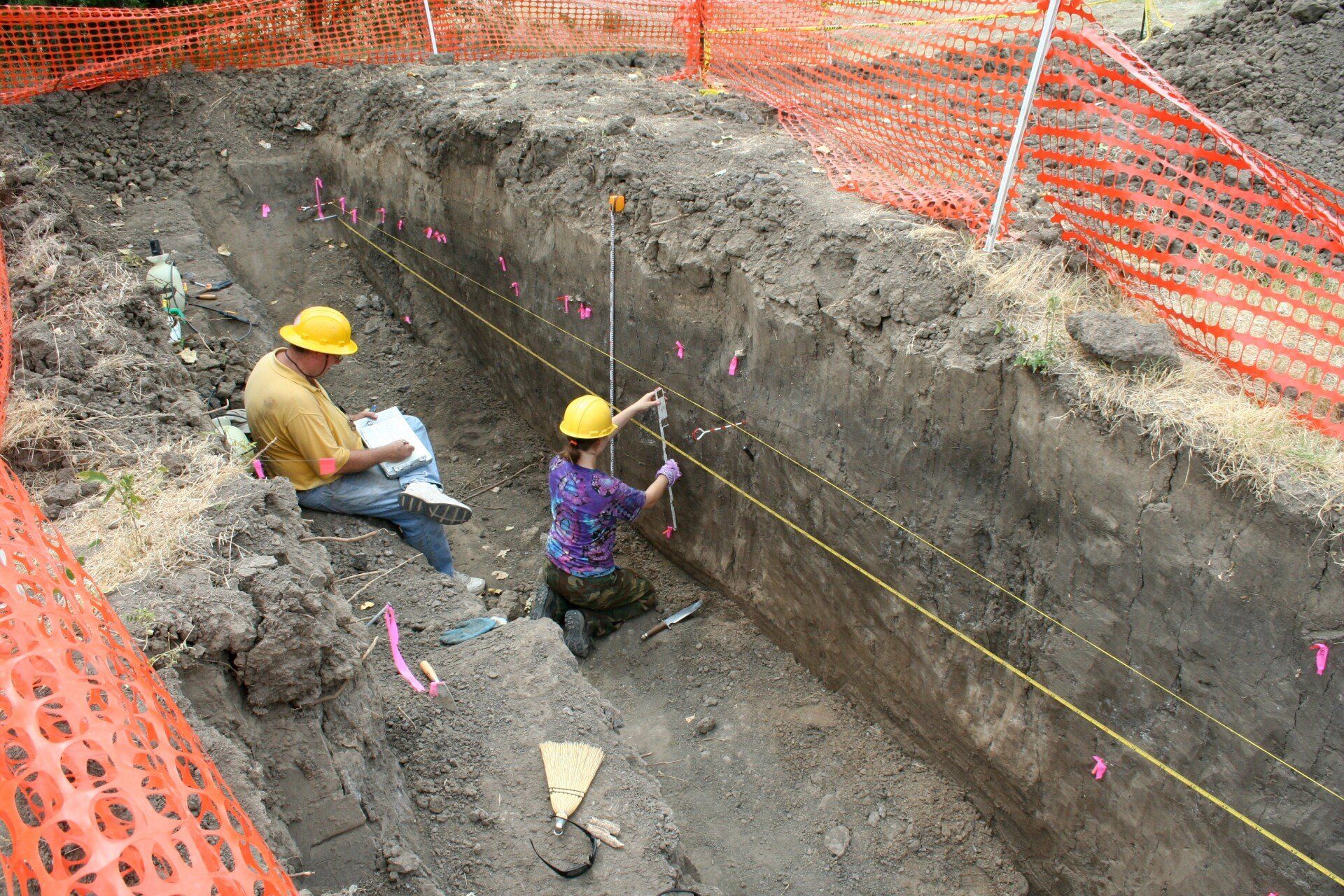
Recording profile of backhoe trench excavated at site 41HM61, Hamilton County, Texas, for the Texas Department of Transportation. Pink pieces of flagging tape identify individual artifacts exposed in a buried cultural layer.
TERRESTRIAL ARCHAEOLOGICAL INVESTIGATIONS
The Cultural Resources Division of Coastal Environments, Inc., (CEI) has helped governmental and private-sector clients meet the requirements of the National Historic Preservation Act for more than half a century. CEI’s professional staff of archaeologists, historians, geographers, GIS specialists, and geologists applies a multi-disciplinary approach to the study, documentation, interpretation, and preservation of the past. Since its founding in 1967, CEI has performed over 800 cultural resources investigations, ranging from small-scale surveys to large-scale, multi-year projects, including Phase I survey, Phase II testing, and Phase III data recovery
- Artifact Conservation and Stabilization
- Historical Archaeology
- Prehistoric Archaeology
- Cartographic Reconstructions
- Historical Investigations
- Standing Structure Surveys
- Cemetery Delineations
- Industrial Archaeology
- Urban Archaeology
- Geoarchaeological Investigations
- Plantations Archaeology
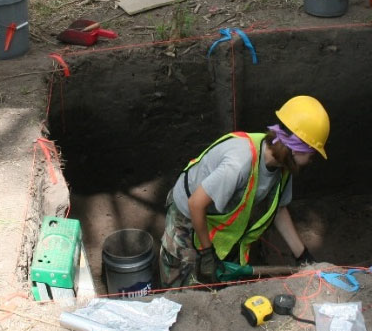
Crew member excavating at the Dimond Knoll site (41HR796), Harris County, Texas, for the Texas Department of Transportation.
UNDERWATER ARCHAEOLOGY
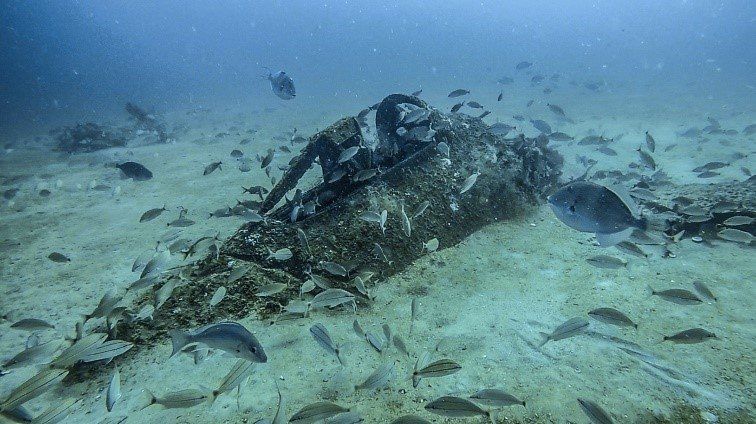
Remains of a Grumman Bearcat (F8F) fighter plane submerged in the Gulf of Mexico off Pensacola, Florida.
Submerged cultural resources include historic shipwrecks and sunken aircraft, as well as submerged prehistoric archaeological sites and their associated landscapes which have become inundated by rising sea levels since the last ice age.
CEI’s Marine Archaeology Division provides a wide range of cultural resource services to support our private and public sector clients. Since its founding in 1967, CEI has performed over 900 cultural resources investigations ranging from small-scale surveys to large-scale, multi-year projects for federal, state, and local governments, oil and gas developers, engineering firms, and non-profits
Coastal Environments Inc. staff has experience in providing Section 106 compliance, geophysical surveys, offshore Qualified Marine Archaeologist support, and diver investigations for projects around the United States and worldwide.
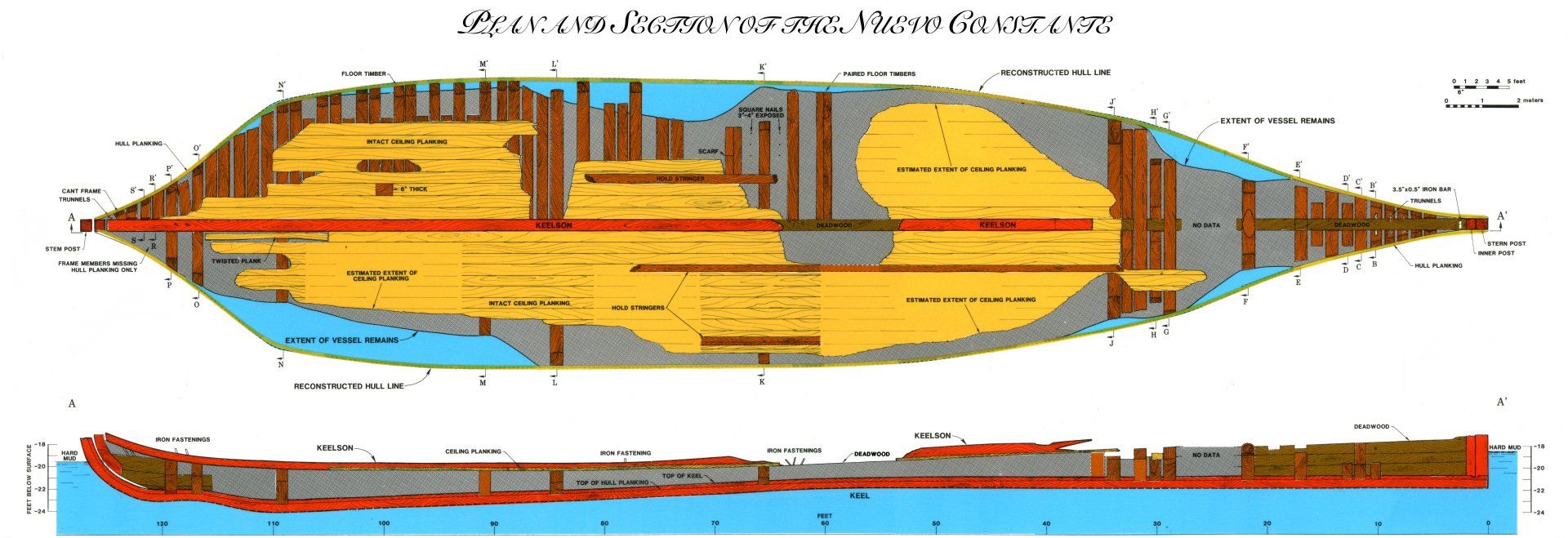
Plan view of the remaining hull of the Nuevo Constante, a Spanish merchant vessel wrecked off the coast of Cameron Parish, Louisiana, during a hurricane in 1766.
Survey Types and Services:
- Geophysical data acquisition, processing, interpretation, and reporting
- Desktop studies, permit acquisition and advice, and Section 106 compliance
- Submerged prehistoric landscapes assessment and Paleoenvironmental reconstruction
- Qualified Marine Archaeologist (QMA) and Client Representative
- Shipwreck and historic resources assessment
- Diver investigations
- Hazards and obstructions surveys
- Directing and coordinating ROV and commercial diver surveys for the offshore energy sector
- Archaeological monitoring plans
- Processing, interpretation, assessment, and reporting of third-party and legacy data
- National Register of Historic Places Nominations
- Artifact conservation and curation
- Project management
CEI maintains both survey and dive vessels necessary for any underwater investigation within inland rivers, coastal bays and estuaries, and the nearshore margin of the Gulf of Mexico
Notable Projects:
- Nuevo Constante, a Spanish merchant vessel sunk in a hurricane in 1766 on the southwestern Louisiana coast
- The USS Eastport, a Union ironclad gunboat sunk in Red River, northwest Louisiana
- CSS Arrow, a Confederate gunboat sunk in the West Pearl River, Louisiana
- SS Mary, a nineteenth-century sidewheel steamer sunk in Aransas Pass, Texas
- Several late-nineteenth- and early-twentieth century vessels sunk in Lake Erie off the coast of Ashtabula County, Ohio.
- 8,000-year-old drowned and buried prehistoric shell midden located ca. 19 feet beneath the bottom of the Gulf of Mexico about eight miles offshore the mouth of the Sabine River.
Our Clients:
Data-Recovery excavations at site 41CL59, Calhoun County, Texas, for the Galveston District, U.S. Army Corps of Engineers.